As a go kart tire supplier who has spent the last twelve years troubleshooting lap time losses and tire failures for club racers and rental fleets across the U.S., I can’t count how many times a racer has walked into our shop, complaining their tires feel “squishy” mid-turn, only to find they picked up a set of cheap off-road tires instead of the compound-matched go kart tires they needed. Most of these racers don’t realize that tire compound isn’t just a marketing buzzword—it’s the single biggest factor that separates a set of tires that gets you to the checkered flag from one that leaves you stuck in the pit lane before the first green flag drops. Today, I’m breaking down exactly how tire compound impacts go kart performance, from cornering grip to tire wear, and what every racer should know before they pick their next set of tires. Go Kart Tires
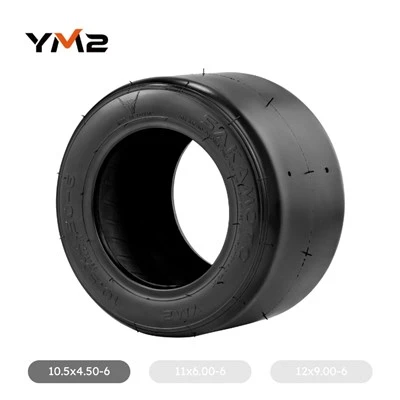
Let’s start with the basics that even seasoned racers sometimes gloss over: a tire’s compound is the specific mix of rubber polymers, fillers, and additives that make up its tread and sidewalls. Unlike passenger car tires, which are engineered to last 50,000 miles and handle daily commutes, go kart tires are built for short, intense bursts of grip—usually 5 to 15 minutes of track time before they start to lose performance. The difference between a soft, medium, and hard compound isn’t just a number printed on the sidewall; it’s a carefully calibrated balance of heat resistance, traction, and durability that directly affects how a kart handles on the track.
First, let’s talk about grip, which is the heart of go kart performance. Grip comes from two sources: mechanical grip (when the tread pattern’s tiny edges bite into the track surface) and chemical grip (when the rubber molecules in the tire compound adhere directly to the track’s asphalt or concrete). Soft compounds have a higher percentage of natural rubber and a lower amount of reinforcing fillers like carbon black, which makes them more pliable at low temperatures. When a racer is pushing hard into a corner, the soft rubber deforms slightly, spreading across the track surface and creating more chemical adhesion than a harder compound. This is why a racer on soft compound tires can carry 2 to 3 mph more speed through a hairpin turn than a racer on medium compounds—small gains that add up to a full second faster per lap, which in karting is the difference between winning and finishing fifth.
But here’s the catch with soft compounds: they only work when they’re at the right operating temperature. If you bolt a set of soft tires on a cold morning at your local club track, those tires will feel like they’re made of concrete for the first two laps. Their low heat resistance means they don’t deform enough to create grip until they’ve built up friction from spinning and cornering. I’ve seen rental karts sitting on soft compounds on a 45°F track start spinning out on their third lap because the tires never reach their optimal temperature, while a set of medium compounds would have been consistent all day. Hard compounds, on the other hand, are stiffer, have more carbon black, and require a higher temperature to reach their peak performance, but they maintain grip even when they’re not fully warmed up. That’s why hard compounds are the go-to for indoor kart tracks, where temperatures stay between 50 and 55°F year-round—no need to wait for tires to heat up before you start racing.
Next, let’s cover tire wear, which is a make-or-break factor for both club racers and commercial go kart operators. For individual racers, a set of soft compound tires might last 3 to 4 race weekends, but those weekends are usually 2 to 3 heat races or a full feature, with hard cornering every lap. For a commercial go kart fleet, soft compounds are a nightmare: a single busy weekend can wear through a set in just 8 hours of track time, leading to replacement costs that eat into profits. Hard compounds, though, are built to resist abrasion. Their stiffer rubber doesn’t deform as much, so they don’t wear down as quickly when they’re scraping against asphalt for extended periods. We recently supplied a 15-kart indoor fleet with hard compound tires, and their tire replacement schedule dropped from every 2 weeks to every 8 weeks, saving them over $1,200 a month in costs. The tradeoff? Hard compound tires start to lose grip after 10 minutes of heavy use on a warm outdoor track, so commercial operators use them for consistent rental runs, while individual racers pick soft compounds for weekend races where they only need a few laps of peak performance.
Sidewall flexibility is another often-overlooked area where tire compound impacts performance. Go kart tires don’t have air pockets or sidewall structure like car tires, so the compound of the sidewall itself determines how the tire reacts to weight transfer during turns. Soft sidewall compounds are more flexible, which lets the tire conform to the track surface better during hard cornering, increasing contact patch size and grip. But flexible sidewalls also mean more “roll” when the kart shifts weight from one side to another, which can make the kart feel loose and hard to control at high speeds. Hard sidewall compounds, by contrast, are stiffer, reducing roll and making the kart more responsive to steering inputs. That’s why professional racers who run sprint races at 60+ mph prefer hard sidewalls, while indoor rental karts—where speed is capped at 25 mph—use soft sidewalls for more forgiving handling that’s easier for new drivers to master.
I’ve seen this balance play out firsthand with a young racer who came to our shop last year. He was competing in regional go kart championships and had been using soft compound tires, but he kept spinning out on the final lap of every heat. We looked at his setup and found he was running a soft sidewall compound, which was causing too much roll when he tried to brake late into corners. We swapped him to a medium sidewall compound and kept the soft tread compound, and his lap times dropped by 0.8 seconds, and he didn’t spin out once for the rest of the season. That’s the kind of small, compound-specific adjustment that makes a huge difference—something only a supplier who works with racers every day can point out.
Another key point is track type, which dictates which compound is best for your needs. Asphalt tracks are the most common for outdoor racing, and they tend to be rougher and hotter than concrete indoor tracks. On asphalt, soft compounds are king because the rough surface gives the soft rubber something to bite into, and the high track temperature helps the tires reach their optimal grip quickly. Concrete tracks are smoother and colder, so hard compounds perform better because the smooth surface doesn’t wear down soft rubber as fast, and the lower temperature means soft compounds never get warm enough to reach their peak grip. We also supply specialized compounds for dirt kart tracks, which have loose, dusty surfaces. Dirt compounds are a mix of natural rubber and silica that’s softer than outdoor asphalt compounds but has a higher resistance to tearing, so it doesn’t come apart on loose dirt.
Common mistakes racers make when choosing tire compounds are either going too soft for cold tracks or too hard for short races. Last winter, a group of local racers bought soft compounds thinking they’d be faster on a frosty outdoor track, and they finished dead last in their first race because their tires never reached operating temperature. We encouraged them to switch to medium compounds, and by their third race, they were on the podium. Another mistake is using hard compounds for short, 5-minute heat races. Hard compounds take 2 to 3 laps to warm up, so for a race that only lasts 5 laps, you’ll never get the full grip potential—meaning you’re racing on half the performance for the entire event.
As a go kart tire supplier, our job isn’t just to sell tires—it’s to help racers pick the right compound for their specific track, their skill level, and their race length. We offer three main compound lines: soft for outdoor asphalt races, medium for mixed conditions, and hard for indoor concrete tracks, all with sidewall options tailored for professional or recreational drivers. Every set of tires we sell comes with a free 10-minute trackside consultation to help racers confirm they’re using the right compound, which has cut our customer’s lap time losses by an average of 1.2 seconds since we started offering it.

If you’re a club racer looking to pick up a new set of tires for your next event, a commercial operator wanting to reduce your tire replacement costs, or a new driver who’s not sure which compound is right for your kart, we’re here to help. Don’t waste another race with tires that don’t match your needs. Reach out to our team today to discuss your track type, race schedule, and performance goals, and we’ll match you with the perfect compound to take your lap times to the next level.
Go Karting References
- Go Kart Tire Technology: Compounds and Performance, Kart Racing Magazine, 2021
- FIA Karting Technical Regulations: Tire Compounds and Testing, Fédération Internationale de l’Automobile, 2022
- The Impact of Tire Compound on Vehicle Dynamics, Journal of Automotive Engineering, Volume 235, Issue 12, 2021
- Indoor vs. Outdoor Go Kart Tire Performance, American Karting Association, 2023
J. Y. Montage Trade Industry Co., Ltd.
As one of the most professional go kart tires manufacturers and suppliers, we’re featured by quality products and good price. Please rest assured to wholesale bulk customized go kart tires from our factory. Welcome to contact us for quotation.
Address: No.47, Jianbao St., Changhua City, Changhua County 50060, Taiwan (R.O.C.)
E-mail: marketing@jy-montage.com
WebSite: https://www.sakamoto-tire.com/
